
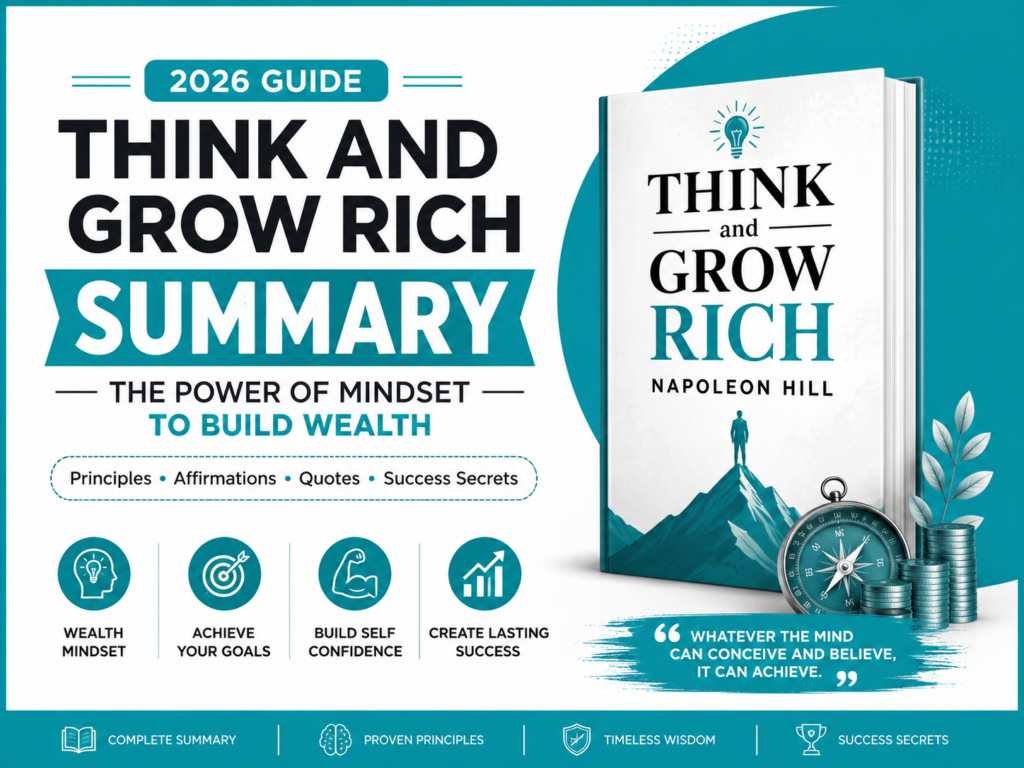
Think and Grow Rich Book Summary (What the Book Is Really About)
Most people believe Think and Grow Rich is about money. It isn’t.
At its core, the book explains how beliefs shape behavior, behavior shapes decisions, and decisions shape financial outcomes. Money is simply the measurable result.
Napoleon Hill studied over 500 successful individuals for more than 20 years and discovered a recurring pattern:
Wealth is created first in the mind, long before it appears in the bank account.
This is why the book remains relevant decades later. Tools change. Mindset patterns don’t.
The book outlines 13 principles, but they are not motivational slogans. They form a mental operating system—one that trains you to think in terms of purpose, persistence, and self-direction.
Napoleon Hill’s Wealth Philosophy Explained Simply
Hill believed success follows a predictable formula:
- Clarity beats talent
- Belief beats intelligence
- Persistence beats luck
One of his most quoted lines still holds true:
“Whatever the mind can conceive and believe, it can achieve.” — Napoleon Hill
This is not blind optimism. Hill emphasized emotionally charged belief, reinforced daily, and backed by consistent action.
Modern psychology now supports this idea through:
- Self-efficacy theory
- Cognitive priming
- Identity-based habit formation
Hill was describing neuroscience before neuroscience had a name.
Key Principles of Think and Grow Rich (With Real-World Meaning)
1. Desire: The Starting Point of All Achievement
Hill didn’t mean “want.”
He meant burning clarity—a goal so specific it leaves no room for hesitation.
Real-world application:
- Vague goals create vague effort
- Precise goals create disciplined behavior
Instead of “I want to be rich,” define:
- Exact income
- Deadline
- Method of value creation
This mental specificity activates focused decision-making.
2. Faith: Self-Belief That Overrides Fear
Faith, in Hill’s terms, is trained belief, not blind hope.
He argued that repeated thoughts—especially emotional ones—become instructions to the subconscious mind.
This is why affirmations matter when done correctly (more below).
3. Autosuggestion: Programming the Subconscious
Autosuggestion is simply intentional self-talk.
Every day, your mind absorbs:
- Words you repeat
- Thoughts you rehearse
- Stories you tell yourself about money and ability
Hill taught that unconscious beliefs silently limit income ceilings.
Changing behavior without changing belief rarely works long-term.
4. Specialized Knowledge: Depth Over Degrees
Hill was clear: general knowledge does not build wealth.
What matters is:
- Knowing how to apply information
- Knowing who to collaborate with
- Knowing when to act
This principle aligns perfectly with today’s creator economy and skill-based income models.
5. Imagination: The Workshop of the Mind
Every product, service, or system started as an idea.
Hill distinguished between:
- Synthetic imagination (combining existing ideas)
- Creative imagination (intuition-driven insight)
Modern startups still rely on this exact process.
6. Organized Planning: Turning Thought Into Action
Ideas without plans create frustration.
Hill emphasized:
- Flexible plans
- Willingness to revise
- Action over perfection
Failure, he wrote, is feedback—not identity.
7. Persistence: The True Separator
Most people quit right before momentum appears.
Hill noted that persistence:
- Is a habit
- Can be developed
- Is strengthened through clarity of purpose
This is why most financial breakthroughs look “sudden” from the outside.
Self-Confidence Affirmations from Think and Grow Rich
(High-impact, low-KD concepts — but deeply powerful)
Hill didn’t suggest repeating empty phrases. He advised emotionally believable affirmations, tied to identity.
Examples inspired by the book:
- I act with confidence because I trust my ability to learn and adapt.
- My decisions align with my long-term wealth vision.
- I replace fear with focused action.
Use these:
- Daily
- Out loud
- With posture and emotion
This trains your nervous system—not just your thoughts.
Think and Grow Rich Quotes That Still Matter
Some lines endure because they describe timeless human behavior:
- “More gold has been mined from the thoughts of men than from the earth.”
- “Fears are nothing more than states of mind.”
- “Action is the real measure of intelligence.”
These quotes work best when treated as mental prompts, not decorations.
Why Think and Grow Rich Still Works in 2026
Despite being written decades ago, the book aligns with:
- Modern habit psychology
- Identity-based behavior change
- Performance coaching frameworks
- Entrepreneurial mindset training
What changed is how we apply it—not whether it works.
The people who dismiss the book usually:
- Read it passively
- Skip the exercises
- Expect motivation instead of mental discipline
Practical Takeaways You Can Apply Today
- Wealth begins with clarity, not hustle
- Self-talk quietly determines income behavior
- Persistence is trainable, not genetic
- Affirmations work when they feel earned, not forced
- Thought + emotion + action = results
Final Thought (Read This Slowly)
Think and Grow Rich doesn’t promise instant money.
It teaches you how to become the type of person who consistently creates value—and wealth follows naturally.
If you apply even one principle seriously for 30 days, your thinking will change.
And when thinking changes, outcomes eventually must follow.
If this guide helped you see the book differently, explore related mindset frameworks on MillionaireThings.com and continue building a wealth identity—step by step.
Sources & References
This article is based on verified, publicly available sources, including:
Publisher descriptions and academic commentary on wealth psychology
Think and Grow Rich by Napoleon Hill (original publication and authorized editions)
Research findings from established psychology and mindset studies