
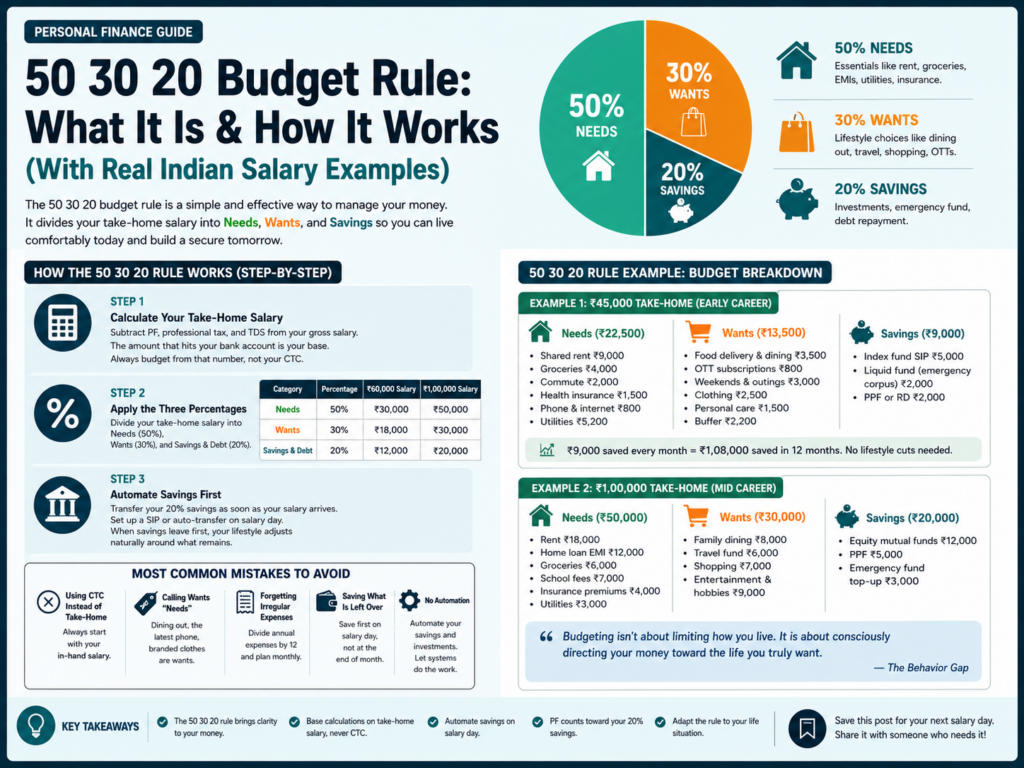
What Is the 50 30 20 Rule?
The 50 30 20 rule is a popular budgeting strategy that organizes your monthly salary into three percentage-based categories, making it easier to manage expenses and savings.
The Three Categories
50% for Needs
Rent, groceries, EMIs, utilities, insurance
30% for Wants
Dining out, OTT subscriptions, travel, shopping
20% for Savings and debt repayment
SIPs, PPF, emergency fund, credit card dues
It was introduced by US Senator Elizabeth Warren in her book All Your Worth (2005).
The entire framework runs on your in-hand salary, not your CTC.
“The secret to financial security is not how much you earn. It is building a system that works regardless of the number.”
— All Your Worth
How Does the 50 30 20 Rule Work? (Step-by-Step)
Step 1: Calculate Your Take-Home Salary
To determine your take-home salary, subtract PF, professional tax, and TDS from your gross monthly income.
The number that hits your bank account is your base.
For a ₹60,000 CTC package, your in-hand might be closer to ₹48,000–₹52,000.
Always budget from that number.
Step 2: Apply the Three Percentages
| Category | Percentage | ₹60,000 Salary | ₹1,00,000 Salary |
| Needs | 50% | ₹30,000 | ₹50,000 |
| Wants | 30% | ₹18,000 | ₹30,000 |
| Savings & Debt | 20% | ₹12,000 | ₹20,000 |
Step 3: Automate Savings First
Transfer your 20% savings the moment your salary arrives, before you touch anything else.
Set up a SIP or auto-transfer on salary day.
When savings leave first, your lifestyle naturally adjusts around what remains.
50 30 20 Rule Example: Budget Breakdown for Two Indian Salaries
Example 1: ₹45,000 Take-Home (Early Career)
Needs (₹22,500)
Shared rent ₹9,000
Groceries ₹4,000
Commute ₹2,000
Health insurance ₹1,500
Phone and internet ₹800
Utilities ₹5,200
Wants (₹13,500)
Food delivery and dining ₹3,500
OTT subscriptions ₹800
Weekends and outings ₹3,000
Clothing ₹2,500
Personal care ₹1,500
Buffer ₹2,200
Savings (₹9,000)
Index fund SIP ₹5,000
Liquid fund (emergency corpus) ₹2,000
PPF or RD ₹2,000
₹9,000 saved every month equals ₹1,08,000 saved in 12 months.
No lifestyle cuts needed.
Example 2: ₹1,00,000 Take-Home (Mid Career)
Needs (₹50,000)
Rent ₹18,000
Home loan EMI ₹12,000
Groceries ₹6,000
School fees ₹7,000
Insurance premiums ₹4,000
Utilities ₹3,000
Wants (₹30,000)
Family dining ₹8,000
Travel fund ₹6,000
Shopping ₹7,000
Entertainment and hobbies ₹9,000
Savings (₹20,000)
Equity mutual funds ₹12,000
PPF ₹5,000
Emergency fund top-up ₹3,000
Budgeting isn’t about limiting how you live. It is about consciously directing your money toward the life you truly want.
— The Behavior Gap
50 30 20 Rule for Beginners: Every Question Answered
What Counts as a Need vs a Want?
A need is something that breaks your daily life if removed.
Rent, food, electricity, transport to work, medication.
A want improves your comfort or enjoyment but is a choice, not a requirement.
The line blurs sometimes. A gym membership is a need if it manages a health condition.
It is a want if you just prefer it to free alternatives.
The rule does not judge. It asks you to be honest.
Is the 50 30 20 Budget Rule Good for Indian Salaries?
Yes, with one adjustment.
In cities like Mumbai or Bangalore, rent alone can consume 30–40% of a lower income.
On a ₹35,000 salary with ₹12,000 rent, you are already at 34% before food, commute, or utilities.
A 2023 BankBazaar survey found only 27% of Indian millennials had a structured savings habit.
If your needs genuinely exceed 50%, move to 60/20/20 temporarily.
Protect the savings bucket above everything else.
Where Do EMIs Fit?
Home loan and vehicle EMIs go under Needs because they fund essential assets.
Personal loan EMIs and credit card dues go under the 20% bucket as debt repayment.
Paying down high-interest debt builds net worth just as effectively as investing.
Most Common Mistakes With the 50 30 20 Budgeting Rule
Using CTC Instead of Take-Home
Your CTC is a hiring number.
Your in-hand salary is your budgeting number.
If your CTC is ₹8 LPA but your in-hand is ₹52,000, every calculation must start from ₹52,000.
Calling Wants “Needs” to Justify Them
Dining out daily, the latest phone, branded clothing are wants.
Labelling them needs does not change what they are.
It just silently eats your savings.
Forgetting Irregular Expenses
Annual premiums, festival shopping, travel, quarterly subscriptions should be divided by 12 and included monthly.
Surprise expenses are only surprising when ignored in planning.
Saving What Is Left Over
Saving at month-end almost never works.
Pay yourself first on salary day.
Set up your finances on autopilot so smart money choices happen automatically without relying on self-control.
When to Adjust the 50 30 20 Rule
The 50 30 20 rule is a starting framework, not a permanent fixed rule.
| Life Situation | Suggested Split |
| High rent city, early career | 60 / 20 / 20 |
| Aggressive debt payoff phase | 50 / 10 / 40 |
| High income, low fixed costs | 40 / 20 / 40 |
| Single income, supporting family | 65 / 15 / 20 |
One insight most Indian guides miss:
Your employer’s PF deduction already counts toward your 20% savings.
If ₹3,600 leaves your salary as PF every month, your voluntary savings target is already partially met.
Key Takeaways
- The 50 30 20 budget rule splits take-home income into Needs (50%), Wants (30%), Savings (20%)
- Always base calculations on in-hand salary, never CTC
- Automate savings on salary day
- PF deductions count toward your 20%
- Adjust the split based on life stage
- Paying off high-interest debt is saving
The 50 30 20 budgeting rule works because it is simple enough to actually use.
You do not need a perfect financial situation to start.
You just need your salary figure and three calculations.
Try it for 60 days and watch how quickly clarity replaces anxiety.